1

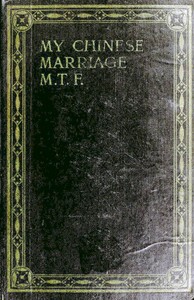
My Chinese Marriage — A Closer Reading
(0 User reviews)
257
Project Gutenberg
2018
Not confirmed
China -- Social life and customs -- 1912-1949; Franking, Mae M.; Americans -- China -- Biography
Readers of public-domain and historical texts
Project Gutenberg digital edition
en
Edition facts
Words
30,470
Reading time
133 min
Text sections
4
My Chinese Marriage — A Closer Reading can be approached with a clearer sense of reading commitment from its source measurements: 30,470 words, 2 hr 13 min estimated reading time, and 4 detected text sections.
The text analysis averages about 19.6 words per sentence, while the detected sections provide another way to judge how the source is divided.
Project Gutenberg metadata also associates the work with “China -- Social life and customs -- 1912-1949,” connecting these edition facts with the source record’s subject description.
Source:
Project Gutenberg record #57382
An editorial note on the language, narrative voice, and changes in pace in Mae M. Franking and Katherine Anne Porter's 'My Chinese Marriage,' based on excerpts from the 1922 memoir.
Read the complete public-domain text at its original source.
Read on Project GutenbergThe narrative voice in My Chinese Marriage shifts between a personal, almost diary-like intimacy and a more detached, observational tone. The opening chapters, set in America, are marked by a brisk, youthful energy: the narrator describes seeing Chan-King Liang for the first time with a casual, almost dismissive interest, noting his 'very black hair' and 'grey suit.' The prose is direct and unadorned, with short sentences that mirror the narrator's initial lack of engagement. As the story moves to Shanghai, the pace slows, and the sentences lengthen, reflecting a deeper immersion in Chinese customs and family life.
A Voice That Grows Accustomed
The narrator's language evolves from a colloquial American idiom to a more measured, descriptive style. Early on, phrases like 'Mrs. James has succumbed!' and 'Looks well enough' convey a breezy, informal tone. Later, in Shanghai, the prose becomes more deliberate: 'I found the deafening drums and gongs a little trying, at moments, and the crude property makeshifts somewhat incongruous with the wonderfully elaborate hangings and costumes.' The shift is not abrupt but gradual, mirroring the narrator's own adjustment to a new culture. The voice retains its first-person perspective throughout, but the observations grow more nuanced, as when the narrator notes the 'tiny gleam of superior wisdom' in her mother-in-law's eyes.
Pace and the Rhythm of Daily Life
The pacing of the narrative is closely tied to the setting. In the American chapters, events unfold quickly: the first meeting, the shared classes, the gradual acquaintance. The prose is economical, with scenes sketched in a few lines. Once in Shanghai, the pace slows considerably. Descriptions of meals, theatre visits, and family interactions are given more space, with details like 'the inevitable pot of tea' and 'steaming hot towels for sticky fingers' anchoring the reader in the sensory world. The narrator's growing comfort is reflected in the unhurried rhythm of the prose, which allows for moments of reflection, such as the realization that 'we were a part of that clan and should be so always.'
Dialogue and the Texture of Two Languages
The excerpts reveal a careful handling of dialogue and language difference. The narrator reports conversations in English, but the presence of Chinese is felt through translation and commentary. When a young woman remarks in Chan-King's native dialect, the narrator understands only through her husband's translation. The mother-in-law's response—'My son, perhaps your wife would like to have some American food now'—is given in English, but the narrator notes it was said in 'clear, gracious tones.' The child Wilfred's 'weird mixture of dialects' adds another layer, showing how language becomes a marker of cultural blending. The narrative voice remains firmly in English, but it acknowledges the polyglot reality of the household.
Readers attentive to shifts in tone and tempo will find that the narrator's voice is the true subject of this memoir. The changes in pace are not merely stylistic but reflect a deepening engagement with a foreign world. The excerpts offer a rich ground for observing how a writer can convey cultural adaptation through sentence rhythm and word choice, without ever needing to state it directly.
That rainy afternoon, I kept returning to the strange, broken rhythm of My Chinese Marriage—how Franking’s voice slips between memory and silence. It made me think of another quiet unease: a duke whose loyalty was never quite trusted. So I picked up Humphrey, Duke of Gloucester: A Biography — Context and Discussion and found the same ache, the same unspoken patience in history’s margins.
There are no reviews for this eBook.
There are no comments for this eBook.
Reader reflection
What was your reading experience?
Capture what you thought, learned, and would like to remember.
Your progress
0
/
10
2
Did this book hold your interest?
3
Is this a title you would suggest to others?
4
What was the reading difficulty like?
5
How strongly did the book affect you emotionally?
6
Would a second reading be valuable?
7
Did any part of the book feel personally relevant?
8
How distinctive were its ideas or approach?
9
What changed or sharpened your thinking?
10