1

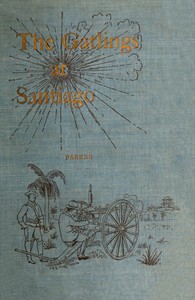
History of the Gatling Gun Detachment, Fifth Army Corps, at Santiago With a Few Unvarnished Truths Concerning that Expedition — Reading Notes
(0 User reviews)
59
Project Gutenberg
2004
Not confirmed
Gatling guns; Spanish-American War, 1898 -- Regimental histories; Spanish-American War, 1898 -- Personal narratives; United States artillery. Gatling gun detachment (5th corps) 1898
Readers of public-domain and historical texts
Project Gutenberg digital edition
en
Edition facts
Words
59,636
Reading time
260 min
Text sections
26
This digital edition of History of the Gatling Gun Detachment, Fifth Army Corps, at Santiago With a Few Unvarnished Truths Concerning that Expedition — Reading Notes is described by source-level measurements including 59,636 words, 4 hr 20 min estimated reading time, and 26 detected text sections.
The text analysis averages about 20.9 words per sentence, while the detected sections provide another way to judge how the source is divided.
Project Gutenberg metadata also associates the work with “Gatling guns,” connecting these edition facts with the source record’s subject description.
Source:
Project Gutenberg record #6888
Lieutenant John H. Parker's firsthand account of commanding the Gatling Gun Detachment at Santiago, blending technical military analysis with blunt observations on logistics, artillery failures, and the conduct of volunteer and regular troops.
Read the complete public-domain text at its original source.
Read on Project GutenbergLieutenant John H. Parker opens his account with a dedication to the enlisted men of his detachment, signaling that this is not a general's memoir but a unit-level narrative. The subtitle promises “a few unvarnished truths,” and Parker delivers a voice that is direct, opinionated, and unsparing. He describes the Gatling guns as a tactical experiment, and his prose reflects the dual role of commander and advocate: he explains the guns’ technical capabilities while defending their performance against what he sees as institutional neglect.
A Commander’s Voice: Diction and Tone
Parker’s language is that of a professional soldier who is impatient with incompetence and proud of his men. He refers to the artillery’s withdrawal as “with more haste than dignity” and calls the behavior of certain units “inscrutable and mysterious phenomena.” His diction is precise when describing equipment—“enfilade several of the enemy’s trenches with machine gun fire”—but turns blunt when assessing other arms: “No American shells had struck the San Juan block-house.” This mix of technical jargon and plainspoken criticism gives the narrative a distinctive, combative tone.
The Texture of Combat: Sensory and Physical Details
Parker grounds his account in physical hardship. After the battle, his men receive “two pieces” of hardtack and “a sup of water” as their only supper; they “lay down in the mud where they stood” and slept through nearby firing. These details—the precise ration, the mud, the exhaustion—convey the reality of campaigning without melodrama. Parker also notes that Private Pyne, “still alive and unhurt,” had been “doing good work against the enemy’s sharpshooters,” a small, specific observation that humanizes the detachment.
Race and Recognition: The 9th and 10th Cavalry
Parker devotes a notable passage to the “colored soldiers” of the 9th and 10th Cavalry who served with his battery. He calls them “the peers of any soldier in the detachment” and praises their willingness, obedience, and energy. He explicitly states that “no soldiers ever fought better than the ‘Brunettes’ of the 9th and 10th Cavalry.” This direct, favorable testimony stands out in a period account and reflects Parker’s willingness to credit soldiers often overlooked by official histories.
Structure and Purpose: Beyond a Simple Narrative
The book is organized into twelve chapters plus appendices, moving from the inception of the Gatling gun scheme through the voyage, battle, and return. Parker includes tactical analysis (Chapter VIII) and a chapter on “The Sufferings of the Fifth Army Corps,” indicating a dual purpose: to record his unit’s actions and to critique the campaign’s logistics and leadership. The inclusion of photographs by Sergeant Weigle, taken under fire, reinforces the documentary intent. Parker’s preface and dedication frame the work as both a tribute and a corrective.
Readers should approach Parker’s narrative as a primary source shaped by a specific agenda: to prove the value of machine guns and to set the record straight from a junior officer’s perspective. His blunt assessments of other units and his praise for the 9th and 10th Cavalry offer insights into contemporary military culture. The excerpts suggest a work that is as much argument as history, best read alongside other accounts of the Santiago campaign.
There’s something touching about reading Parker’s blunt, weary account of that detachment—how the grand plans fray against mud, heat, and missteps. I found myself thinking of the quieter disappointments in Leigh Hunt's Relations with Byron, Shelley and Keats — Key Ideas to Explore. Friendship, like warfare, rarely goes as the manuals predict. Both books sit on my shelf now, worn at the edges, almost friends themselves.
There are no reviews for this eBook.
There are no comments for this eBook.
Reader reflection
What did you think of this book?
Answer a few questions and save a private reflection on this device.
Your progress
0
/
10
2
How much did you enjoy the reading experience?
3
Is this a title you would suggest to others?
4
Did the language feel accessible?
5
Did the book meet your expectations?
6
How useful were the ideas in this book?
7
How closely did the book connect with your experience?
8
How clear did the writing feel?
9
In one sentence, what did you learn?
10