1

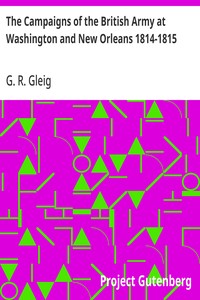
The Campaigns of the British Army at Washington and New Orleans 1814-1815 — Context and Discussion
(0 User reviews)
70
Project Gutenberg
2006
Not confirmed
New Orleans, Battle of, New Orleans, La., 1815; United States -- History -- War of 1812 -- Personal narratives; United States -- History -- War of 1812 -- Campaigns; Washington (D.C.) -- History -- Capture by the British, 1814
Readers of public-domain and historical texts
Project Gutenberg digital edition
en
Edition facts
Words
89,653
Reading time
390 min
Text sections
26
The source record for The Campaigns of the British Army at Washington and New Orleans 1814-1815 — Context and Discussion measures this digital text at 89,653 words, 6 hr 30 min estimated reading time, and 26 detected text sections.
The text analysis averages about 33.6 words per sentence, while the detected sections provide another way to judge how the source is divided.
Project Gutenberg metadata also associates the work with “New Orleans, Battle of, New Orleans, La., 1815,” connecting these edition facts with the source record’s subject description.
Source:
Project Gutenberg record #18479
Gleig's firsthand account of the British campaigns against Washington and New Orleans in 1814-1815, based on a contemporaneous journal. The narrative reveals authorial choices in diction, dialogue, and description, offering a soldier's perspective on military maneuvers, leadership, and the chaos of war.
Read the complete public-domain text at its original source.
Read on Project GutenbergGleig opens his narrative with a claim to authenticity, stating it was compiled from a journal kept during the expedition. This grounding in immediate observation shapes the work's voice: direct, circumstantial, and often understated. The author's position as a chaplain and subaltern allows him to move between the ranks, noting both the general's decisions and the soldiers' straggling march. His descriptions of maneuvers—such as the cool performance of a rally under false alarm—reveal a writer attentive to the contrast between parade-ground order and battlefield reality.
Voice of the Participant-Observer
Gleig's prose is marked by a deliberate plainness. He describes the army breaking into a straggling column, then instantly forming line at the bugle's sound, noting that the maneuver was performed as steadily as on a parade in England. This comparison to peacetime drill is a recurring device, highlighting the tension between training and combat. His diction favors concrete verbs—"wheeled," "sounded," "checked"—over abstract commentary. When he recounts the false alarm caused by an American squadron, he notes dryly that the enemy "succeeded in making two prisoners" before being driven back. The understatement is characteristic; Gleig rarely amplifies danger or heroism, letting the sequence of actions speak.
Description of Leadership and Decision-Making
Gleig evaluates commanders with a mixture of respect and critical distance. He praises General Ross's courage but notes that he "threw his valuable life away" by exposing himself in a trifling skirmish. The phrasing is blunt, almost clinical. He attributes the plan of the New Orleans expedition to Ross's skill and resolution, yet immediately qualifies: "of what a man might have done, I have nothing to say." This restraint is typical. Gleig credits Lieutenant Evans for the order of battle, but remains silent on the council of war's decision to retreat, writing only "I choose to be silent." Such gaps in the narrative are themselves revealing; the author signals that some judgments are withheld, perhaps out of discretion or incomplete knowledge.
Structure and Pacing in the Narrative
The chapter titles in the table of contents are notably terse: "March—Halt—Search—March—Rally—Halt." This staccato pattern mirrors the rhythm of the campaign itself—a series of movements, pauses, and alarms. Within the text, Gleig often compresses time with phrases like "in an instant" or "immediately after," creating a sense of urgency. Yet he also lingers on logistical details: the lifting of artillery into boats, the extension of light troops to cover embarkation. The alternation between swift action and patient description gives the narrative a documentary quality. The author's journal origins are evident in the episodic structure; each day's events are recorded with a diarist's eye for sequence rather than dramatic arc.
Recurring Details and Their Implications
Certain details recur across the excerpts. The army's use of "little tents made with blankets and ramrods" appears as a makeshift solution, underscoring the expedition's improvisational character. The phrase "the same blunders were committed" echoes Gleig's earlier criticism of American tactics, suggesting a pattern he finds instructive. He also notes the absence of pursuit after the British retreat, remarking that the rear-guard had "only the honour of being the last to quit the shore." The irony is quiet but pointed. These repeated observations—of hasty encampments, of missed opportunities, of the gap between plan and execution—build a cumulative picture of a campaign marked by both competence and futility.
Gleig's account is best read as a participant's record, not a strategic analysis. He offers no grand thesis, only the sequence of events as they appeared to a well-placed observer. Readers should attend to what he chooses to describe in detail—the mechanics of embarkation, the behavior of troops under alarm—and what he passes over in silence. The narrative's value lies in its immediacy and its author's willingness to let contradictions stand: courage and waste, order and confusion, success and retreat.
That rainy day, I traced Gleig’s weariness through burning Washington, then sat with the quiet ache of it. The chaplain’s own wars—of the soul, not the sword—came to mind, though I’d never opened his life. Later, almost by accident, I found The Biography of Robert Murray M'Cheyne — Story, Setting & Ideas beside my teacup, and the rain kept falling, softer now.
There are no reviews for this eBook.
There are no comments for this eBook.
Reader reflection
Take a moment to reflect on this book
Create a short personal record of your experience with this book.
Your progress
0
/
10
2
Did this book hold your interest?
3
How likely are you to recommend this book?
4
How easy was the book to follow?
5
Did anything about the book feel genuinely new?
6
Do you expect to return to this book?
7
How useful did the reading feel?
8
What did you think about the pace?
9
What is the main idea you are taking away?
10