1

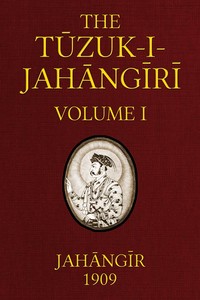
The Tuzuk-i-Jahangiri: or, Memoirs of Jahangir (Volume 1 of 2) — Inside the Classic
(0 User reviews)
1037
Project Gutenberg
2016
Not confirmed
Mogul Empire; India -- Kings and rulers -- Biography; India -- History -- 1526-1765; Jahangir, Emperor of Hindustan, 1569-1627
Readers of public-domain and historical texts
Project Gutenberg digital edition
en
Edition facts
Words
195,871
Reading time
852 min
Text sections
34
The catalog record for The Tuzuk-i-Jahangiri: or, Memoirs of Jahangir (Volume 1 of 2) — Inside the Classic provides practical reading context through 195,871 words, 14 hr 12 min estimated reading time, and 34 detected text sections.
The text analysis averages about 20.6 words per sentence, while the detected sections provide another way to judge how the source is divided.
Project Gutenberg metadata also associates the work with “Mogul Empire,” connecting these edition facts with the source record’s subject description.
Source:
Project Gutenberg record #53674
Jahangir's first-person memoirs, translated by Alexander Rogers and edited by Henry Beveridge, blend imperial record-keeping with personal observation. The narrative shifts between administrative decrees, hunting expeditions, and natural phenomena, revealing the emperor's voice through precise dating, gift inventories, and occasional wonder at unusual events.
Read the complete public-domain text at its original source.
Read on Project GutenbergThe Tuzuk-i-Jahangiri opens with a preface that immediately establishes the text's textual history: the translation was made from Sayyid Ahmad's 1863–64 edition, which was based on a single defective manuscript. Editor Henry Beveridge collated this with superior manuscripts in the India Office and British Museum, correcting numerous errors, especially in proper names. This editorial apparatus frames the memoirs not as a transparent window onto Jahangir's reign, but as a reconstructed document, shaped by the choices of translators and editors. The work itself, however, is Jahangir's own first-person narrative, a hybrid of imperial diary, administrative ledger, and personal reflection.
The Emperor's Voice: Precision and Personal Observation
Jahangir's narrative voice is characterized by a meticulous attention to dates, names, and quantities. Entries are anchored by specific days of the month and year, often with both Persian and solar calendar references. For example, he records that on Thursday, the 13th Amurdād, he embarked on a boat for hunting, and that by the 6th S͟hahrīwar, 47 antelope had been killed. This precision extends to gifts and rewards: a ruby from Dilāwar K͟hān is noted, as is the increase of Hasan ʿAlī Turkumān's mansab by 500 personal and 100 horse. Yet within this bureaucratic framework, personal details emerge. Jahangir mentions saying his prayers, visiting his father's mausoleum, and being pleased by a halting-place prepared by Mahābat K͟hān. The voice is that of a ruler who is both administrator and individual, recording the world with a steady, observant eye.
Narrative Rhythm: Between Routine and the Extraordinary
The memoirs alternate between the routine of court life and the intrusion of the unusual. A typical entry might list appointments, gifts, and hunting yields, but then pivot to a remarkable event. In one excerpt, a news-writer reports that ten men took shelter under a tree during a dust-storm; nine died, and birds and wild beasts also perished. Jahangir notes this with a brief, almost clinical description: "such bad air was created that numerous birds… all fell down and died." The contrast between the orderly progression of imperial business—weighing ceremonies, embassy departures, jagir inspections—and these sudden, unexplained phenomena creates a distinctive narrative rhythm. The emperor moves from the predictable to the strange without commentary, letting the events speak for themselves. This juxtaposition suggests a worldview in which the natural and the political are intertwined, both subject to the same recording gaze.
The Texture of Courtly Exchange: Gifts, Honors, and Hierarchy
Jahangir's memoirs are dense with the material culture of Mughal courtly exchange. Gifts are itemized with care: a jewelled saddle, a sword, an aigrette, a dagger with a pendant of royal pearls. The value of offerings is sometimes specified, as when Yādgār ʿAlī receives 30,000 rupees in cash, making a total of 40,000 rupees. These transactions are not mere lists; they map relationships of loyalty, favor, and rank. The emperor accepts offerings from nobles, bestows honors in return, and records the upgrading of mansabs. The physical objects—elephants, rings, cloth stuffs—become markers of status and connection. Even the act of alighting at a noble's house on the riverbank is a gesture of favor. Through these details, the memoirs reveal the intricate web of obligation and prestige that sustained the empire, rendered in the emperor's own hand.
Readers approaching the Tuzuk-i-Jahangiri should attend to the interplay between the emperor's personal voice and the editorial framework that shapes the text. The memoirs are not a seamless autobiography but a layered document, filtered through translation and manuscript collation. Jahangir's own prose rewards close reading for its shifts in pace—from the methodical recording of court business to the sudden, stark accounts of natural disaster. The work offers a direct, if mediated, encounter with a Mughal emperor's mind, grounded in the concrete details of his world.
There’s something touching about an emperor noting the exact weight of a ruby, then pausing to marvel at a strange bird. That blend of ledger and wonder stays with you. It reminds me of another quiet record-keeper, whose own days mixed duty with devotion—Memoirs of the Right Rev. Daniel Corrie, LL.D., first Bishop of Madras — Themes and Context—and I find myself still thinking about both, long after closing the pages.
There are no reviews for this eBook.
There are no comments for this eBook.
Reader reflection
Before you leave, reflect on the book
Use these questions to collect your thoughts before moving on.
Your progress
0
/
10
2
Was reading this book enjoyable?
3
Would you pass this book on to a friend?
4
How easy was the book to follow?
5
Did it raise ideas you would like to talk about?
6
Did the book meet your expectations?
7
Which part made the strongest impression?
8
How distinctive were its ideas or approach?
9
Which lesson or insight stayed with you?
10