1

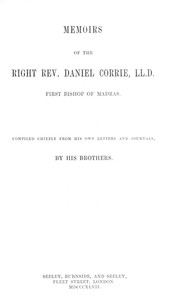
Memoirs of the Right Rev. Daniel Corrie, LL.D., first Bishop of Madras — Themes and Context
(0 User reviews)
2297
Project Gutenberg
2025
Not confirmed
Corrie, Daniel, 1777-1837; Church of England -- Bishops -- Biography; Church of England -- Missions -- India
Readers of public-domain and historical texts
Project Gutenberg digital edition
en
Edition facts
Words
198,983
Reading time
866 min
Text sections
39
The catalog record for Memoirs of the Right Rev. Daniel Corrie, LL.D., first Bishop of Madras — Themes and Context provides practical reading context through 198,983 words, 14 hr 26 min estimated reading time, and 39 detected text sections.
The text analysis averages about 21.6 words per sentence, while the detected sections provide another way to judge how the source is divided.
Project Gutenberg metadata also associates the work with “Corrie, Daniel, 1777-1837,” connecting these edition facts with the source record’s subject description.
Source:
Project Gutenberg record #75863
This editorial note examines the editorial framing of Daniel Corrie's memoirs, focusing on the tension between his private letters and the public persona constructed by his brothers, the strategic use of 'small things' to validate missionary work, and the careful negotiation of native agency in Benares.
Read the complete public-domain text at its original source.
Read on Project GutenbergThe editors of these Memoirs—Corrie’s own brothers—openly acknowledge a risk: that by drawing chiefly from his letters and journals, they might misrepresent him. Yet they proceed, and the resulting volume is shaped by a double consciousness: Corrie’s own voice, often provisional and self-deprecating, and the editorial desire to present a coherent model of missionary perseverance. The preface frames the early labours as a testing ground for principles, and the excerpts bear this out. Corrie writes of doing ‘a little: unknown and yet well known,’ a phrase that captures the modesty and the sense of unseen significance that pervades the record.
The Editorial Frame: Brothers as Gatekeepers
The preface is unusually candid about its limitations. The editors note that the brother who began the work fell ill and died, and the surviving brother completed it ‘in his turn, not altogether free from those interruptions which arise out of the duties and afflictions of ordinary life.’ This personal note colours the entire volume. The editors state they gave ‘copious details’ of early labours because those years ‘most severely tested’ Corrie’s principles. The reader is thus warned: the selection is purposeful, not neutral. The letters are not presented raw; they are curated to illustrate a thesis about perseverance under trial. The editors also acknowledge debts to the Lord Bishop of Oxford and others for letters, hinting at a network of correspondents whose voices are filtered through the editorial lens. This framing invites the reader to consider not just Corrie’s life, but the act of memorializing itself.
‘A Little, Unknown and Yet Well Known’: The Rhetoric of Small Beginnings
Corrie’s own language repeatedly minimizes achievement while claiming divine significance. In an August letter to Mr. Sherer, he writes: ‘We are going on as usual here, doing a little: “unknown and yet well known.”’ The quotation marks suggest he is citing a scriptural or familiar phrase, grounding his modest report in a larger narrative. This pattern recurs: he describes a high-caste relative of the Rajah of Benares taking away a Hindoostanee New Testament ‘with evident desire, after a long discussion.’ The emphasis is on the native’s initiative, not Corrie’s persuasion. Similarly, Joy Narain’s school is described as proceeding ‘very well,’ with ‘many of good caste and family’ coming for English instruction. Corrie adds that he ‘is obliged to refrain at times from talking with them, lest the whole design should be obstructed by the rapid progress some of them are making.’ The tension between eagerness and restraint is palpable. The editors, by including such passages, reinforce the idea that small, cautious steps are the proper missionary method.
Native Agency and the Limits of the Record
The excerpts reveal a careful negotiation with native elites. Corrie notes that several high natives visited him ‘chiefly from the intimacy they perceived Mr. Bird had formed with us.’ The visits led to religious discussions, but Corrie presents these as almost accidental. The most substantial document in the excerpts is the statement of the school’s plan, drafted by Corrie at Joy Narain’s request. The statement is remarkable for its secular tone: it lists four languages taught, provisions for poor boys, and a curriculum including ‘government regulations on the subjects of police, and ordinary affairs.’ The ‘primary design’ is to enable youths to obtain ‘a comfortable livelihood.’ Only in the final clause does the religious aim appear indirectly. The editors call this document ‘illustrative of a remarkable moral movement,’ but the text itself is a practical charter. The reader is left to wonder how much of the school’s religious character was explicit in practice. Corrie’s own letters suggest he was cautious not to ‘obstruct’ progress by moving too fast. The excerpts do not reveal the outcome of these efforts, leaving the reader with a sense of incomplete knowledge—a fitting limitation for a memoir that is itself a selection.
Readers approaching these Memoirs should attend to the editorial apparatus as much as to Corrie’s own words. The brothers’ preface, the network of acknowledgments, and the strategic inclusion of documents like the school statement all shape the portrait. The excerpts offer a fragmentary view: we see Corrie in Benares, cautious and observant, but we do not see the later bishop. The volume’s length—nearly 200,000 words—suggests a wealth of material beyond these glimpses. The reader is invited to trace how the ‘day of small things’ is sustained across decades, and to consider what the editors chose to leave out.
Reading Corrie’s private letters, I was struck by how carefully his brothers smoothed his edges. Those quiet, unguarded moments felt like the living breath underneath the official portrait. It reminded me of similar voices gathered elsewhere—ordinary people speaking plainly, their words preserved despite the framing around them—in Slave Narratives: A Folk History of Slavery in the United States from Interviews with Former Slaves, Volume IV, Georgia Narratives, Part 3 — Key Ideas to Explore. Both left me wondering who gets to tell the story.
There are no reviews for this eBook.
There are no comments for this eBook.
Reader reflection
Before you leave, reflect on the book
Use these questions to collect your thoughts before moving on.
Your progress
0
/
10
2
How did the book work for you overall?
3
How likely are you to recommend this book?
4
How easy was the book to follow?
5
Which aspect of the book did you value most?
6
Was the book easy to understand?
7
Do you expect to return to this book?
8
How valuable was this book for your own interests?
9
What changed or sharpened your thinking?
10