1

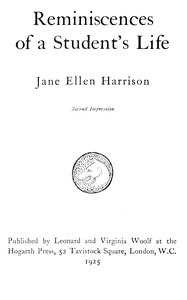
Reminiscences of a student's life — A Reader’s Guide
(0 User reviews)
1177
Project Gutenberg
2025
Not confirmed
Autobiographies; Harrison, Jane Ellen, 1850-1928; Classicists -- Great Britain -- History -- 20th century -- Biography; Historians -- Great Britain -- 20th century -- Biography
Readers of public-domain and historical texts
Project Gutenberg digital edition
en
Edition facts
Words
21,864
Reading time
96 min
Text sections
7
The catalog record for Reminiscences of a student's life — A Reader’s Guide provides practical reading context through 21,864 words, 1 hr 36 min estimated reading time, and 7 detected text sections.
The text analysis averages about 18.2 words per sentence, while the detected sections provide another way to judge how the source is divided.
Project Gutenberg metadata also associates the work with “Autobiographies,” connecting these edition facts with the source record’s subject description.
Source:
Project Gutenberg record #75986
Jane Ellen Harrison's memoir moves from a Yorkshire childhood where 'Moscow' was a dog, through Cambridge academic circles, to reflections on memory and identity, structured by recurring images of Russia, food, and the tension between public and private selves.
Read the complete public-domain text at its original source.
Read on Project GutenbergJane Ellen Harrison opens her memoir not with a birth or a family tree, but with a dog named Moscow. That dog, chained under a gum-exuding tree, becomes the first of many objects that carry her across borders—between childhood and scholarship, between England and a Russia she has never visited. The word 'Moscow' itself, she writes, once meant only a Newfoundland dog; learning later that it was a cathedral city made her 'universe rock with Einsteinian relativity.' This early collision of private meaning and public fact sets the pattern for a book built from such collisions: a reindeer tongue that tastes of 'snow-fields and dreaming forests,' a toy called 'The Siege of Sevastopol' that she hated but whose name she savored. Harrison's structure is associative, not chronological; she moves by image and echo, not by date.
Objects That Carry Worlds
Harrison’s memory fastens on things that are more than themselves. The reindeer tongues sent each Christmas by a Russian business contact are not just food; they are portals to 'snow-fields and dreaming forests.' A tiny Russian sledge, imported by her father, holds only one person—'so I could dream undisturbed of steppes and Siberia and bears and wolves.' The toy siege of Sevastopol, though she hated its soldiers and bayonets, gave her the word 'Sevastopol' itself, which she 'turned over and over' as a 'soft joy' to her child’s mouth. When she later learned its Greek etymology, she felt 'a real fitness in things.' These objects are not props; they are the hinges on which her inner life turns. They allow her to move between the Yorkshire backyard and a vast, imagined Russia, between a child’s sensory pleasure and an adult’s philological satisfaction. The structure of the memoir follows this logic: a thing appears, and the world around it expands.
The Social Geometry of Cambridge
When Harrison moves from childhood to Cambridge, the objects recede and people take their place—but the associative structure remains. She describes the Cambridge academic circle not by listing achievements but by arranging figures in a social constellation. Henry Sidgwick is 'the centre'; Frederick Myers 'rang, perhaps, the most sonorously of all, but to me he always rang a little false'; Edmund Gurney is 'the most lovable and beautiful human being I ever met.' The Psychical Research circle, with its quest for 'scientific proof of immortality,' she calls 'inspiring' even if the phrase now seems 'grotesque.' She places Mrs. Henry Sidgwick 'in the midst of them' shining 'like a star,' and recounts a characteristic anecdote: Mrs. Sidgwick, challenged on her use of the word 'alight,' later admits she does not actually say it but 'think[s] I always shall now.' Harrison’s portraits are not static; they are built from small, revealing actions—a cautious concession, a plaintive remark about account books, a laugh that begins love.
The Laughter That Accompanies Affection
Harrison repeatedly notes that those she most admires also move her to mirth. Of Mrs. Sidgwick she writes, 'how I adored her! how she made me laugh!' and then generalizes: 'As soon as we laugh at a person we begin a little to love them.' This observation is not a passing remark; it is a structural principle of the memoir. The laughter is never cruel. It arises from the gap between a person’s public role and their private self—Mrs. Sidgwick’s 'perfect passion for accounts' and her 'meticulously true' nature, which makes her walk 'through a vulgar and wicked world in perpetual blinkers.' Harrison herself is often the object of such affectionate comedy: a young prig writes her a patronizing letter about doing 'Grates' at Oxford; her brother at Harrow hopes she will not lecture there because it would be 'awkward.' She reports these moments without bitterness, as evidence of the social friction that defined a woman scholar’s life in early twentieth-century England.
Movement Between Worlds
The memoir’s structure is one of constant movement: from Yorkshire to Cambridge, from childhood to professional life, from England to an imagined Russia. But the movement is not linear. Harrison loops back—to the taste of reindeer tongue, to the sound of the word 'Sevastopol,' to the dog Moscow. These recurrences give the book its texture. A single object can bridge decades: the Russian sledge of her childhood reappears in the adult scholar’s love of Russian things. The structure is less a timeline than a web of associations. Harrison does not explain her transitions; she lets one image summon the next. The result is a memoir that feels less like a retrospective account and more like a series of vivid, connected moments—each one a point where a private memory meets a public world, and where the reader is invited to see the pattern without having it spelled out.
Harrison’s memoir rewards a reader who attends to its small, precise details—the gum-drops within a dog’s chain, the taste of cranberry sauce, the word 'alight' spoken or not spoken. These are not decorations; they are the evidence from which the book builds its larger claims about memory, identity, and the life of the mind. Because the structure is associative, the reader may find it useful to read slowly, letting each image settle before moving to the next. The book does not argue; it presents. What it presents is a mind at work, turning over the world as the child turned over the word 'Sevastopol,' finding in each thing a 'soft joy' that is also a kind of knowledge.
Reading Jane Ellen Harrison’s memoir, I kept circling back to her quiet insistence on the self we build in private—the one that outlives lectures and accolades. That same gentle excavation lives in the Biography of Rev. Hosea Ballou — Inside the Classic, where a public man’s doubts feel almost like old photographs, faded but familiar, waiting to be acknowledged.
There are no reviews for this eBook.
There are no comments for this eBook.
Reader reflection
Record your reading impressions
A brief reflection can help important ideas stay with you longer.
Your progress
0
/
10
2
How much did you enjoy the reading experience?
3
Would you pass this book on to a friend?
4
What was the reading difficulty like?
5
How strong was your personal connection to the text?
6
Did the book deliver what you hoped for?
7
How valuable was this book for your own interests?
8
Would you read this book again?
9
What is the main idea you are taking away?
10