
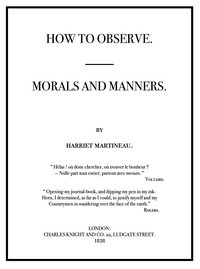
How to Observe: Morals and Manners by Harriet Martineau
Published in 1838, How to Observe: Morals and Manners isn't a story with a plot in the traditional sense. Think of it as a field guide, written by one of the first true sociologists, Harriet Martineau. She wrote it as part of a series to help British travelers understand foreign countries, but its lessons are universal.
The Story
There's no protagonist or villain here. The "story" is Martineau's argument. She believed that to truly know a nation, you must look past its government proclamations and grand monuments. The real truth, she insisted, lives in the manners—the daily habits, social interactions, and domestic life. How do people behave in their homes? What do they value in education? How do different social classes interact in casual settings? She thought these observable behaviors were the clearest window into a society's core morals, its fundamental beliefs about right and wrong. The book is structured as a series of principles and warnings. She tells readers to beware of their own prejudices, to question official sources, and to pay close attention to what she calls "the lesser matters"—the treatment of women, the state of prisons, the conversations in a tavern. It's a masterclass in shifting your gaze from the stage to the audience to understand the whole play.
Why You Should Read It
This book is a quiet thrill for the curious mind. Reading Martineau feels like having a brilliant, no-nonsense friend point out everything you've been missing. Her voice is direct and surprisingly modern. She calls out the lazy thinking of tourists who judge a place by its hotels and calls for a deeper, more empathetic form of observation. What I love most is how it reframes your own life. You start applying her lens everywhere. Waiting in line at the grocery store, scrolling through social media, watching a political debate—you begin to see the unspoken "manners" and the "morals" they might point to. It turns you from a passive viewer into an active interpreter of the human world. It’s also a fascinating historical artifact, showing the birth of social science from a woman who had to fight to be heard.
Final Verdict
Perfect for travelers, history lovers, and anyone who enjoys people-watching with a purpose. If you like the ideas of Malcolm Gladwell or Atul Gawande—writers who decode the hidden systems of everyday life—you'll find Martineau to be a pioneering ancestor. It's not a light beach read, but it's a short, potent one that will genuinely change how you see the world, both past and present. Give it a try if you're ready to become a better observer of your own society.
Legal analysis indicates this work is in the public domain. It is available for public use and education.
Matthew Garcia
4 months agoLooking at the bibliography alone, the breakdown of complex theories into digestible segments is masterfully done. Definitely a five-star contribution to the field.
Karen White
6 months agoI appreciate how this edition approaches the core problem, the author manages to bridge the gap between theory and practice effectively. Thanks for making such a high-quality version available.
Kimberly Miller
1 year agoThis was exactly the kind of deep dive I was searching for, the inclusion of diverse viewpoints strengthens the overall narrative. A rare gem in a sea of mediocre content.
Karen Hernandez
1 month agoI've gone through the entire material twice now, and the footnotes provide extra depth for those who want to dig deeper. The price-to-value ratio here is simply unbeatable.








Sarah Harris
2 months agoThe clarity of the introduction set high expectations, and the step-by-step breakdown of the methodology is extremely helpful for students. I'll be recommending this to my students and colleagues alike.