
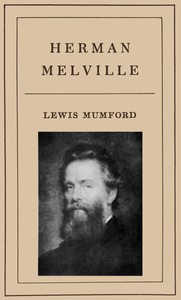
Herman Melville by Lewis Mumford
Most biographies give you a timeline of facts. Lewis Mumford's book about Herman Melville gives you a portrait of a soul. Mumford, writing in 1929, was part of the movement that rescued Melville from obscurity. He doesn't just list where Melville went and what he published. He shows us how the man's life became his art.
The Story
The book follows Melville's journey from his adventurous youth as a sailor—experiences that fueled early successes like Typee and Omoo—to the creation of his masterpiece, Moby-Dick. Mumford paints a vivid picture of Melville's intense friendship with Nathaniel Hawthorne, which pushed him to write deeper, darker, and more philosophically complex work. Then, the story takes a turn. Despite his genius, Melville's later books confused and alienated readers. Financial pressures and family tragedy mounted. The narrative then focuses on Melville's long, quiet retreat from the literary spotlight, his decades as a customs inspector, and the private poetry he wrote, almost in secret. Mumford frames this not as a failure, but as a different kind of survival, arguing that Melville's inner life never dimmed.
Why You Should Read It
This book changed how I see artists. It’s not a hero's tale of constant triumph. It’s a real, sometimes painful, look at what it costs to have a vision that's ahead of its time. Mumford makes you feel the frustration Melville must have felt when his greatest work was met with shrugs. But he also shows the quiet dignity in Melville's later years. There’s something incredibly powerful about the image of this man, who wrote about cosmic battles with white whales, patiently checking cargo manifests by day and writing profound poetry by night. It’s a story about persistence without fame, about keeping your creative flame alive even when no one is watching. It made me appreciate Moby-Dick not as a lonely classic, but as a volcanic eruption from a specific, fascinating, and deeply human mind.
Final Verdict
Perfect for readers who love Moby-Dick and want to meet the man behind the whale. It's also great for anyone interested in the messy, non-linear path of a creative life. If you enjoy biographies that feel like psychological explorations rather than history reports, you'll love Mumford's passionate and thoughtful take. It’s a short, compelling read that proves the story behind a great book can be just as gripping as the book itself.
This work has been identified as being free of known copyright restrictions. Preserving history for future generations.
Margaret Davis
11 months agoI've been looking for a reliable source on this topic, and the way the author breaks down the core concepts is remarkably clear. This should be on the reading list of every serious professional.
Ashley Johnson
1 month agoHaving read the author's previous works, the way the author breaks down the core concepts is remarkably clear. The price-to-value ratio here is simply unbeatable.
Charles Lopez
1 year agoI found the author's tone to be very professional yet accessible, it manages to maintain a consistent flow even when discussing difficult topics. This adds significant depth to my understanding of the field.







Michael Lee
7 months agoUnlike many other resources I've purchased before, the formatting on mobile devices is surprisingly crisp and clear. A mandatory read for anyone in this industry.