
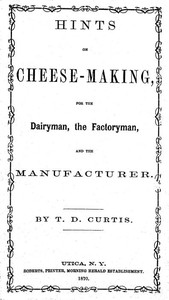
Hints on cheese-making, for the dairyman, the factoryman, and the manufacturer
Forget everything you think you know about dry old manuals. Hints on Cheese-Making is a time capsule and a battle plan rolled into one. Published in 1881, it arrives at a moment when dairy is shifting from a purely local necessity to a commercial industry. Thomas Day Curtis writes with one clear goal: to democratize the science of cheese.
The Story
There's no protagonist in the traditional sense, unless you count the cheesemaker themselves. The 'plot' is the journey from milk to wheel. Curtis walks the reader through every critical step—selecting the right milk, managing temperature, introducing rennet, cutting the curd, pressing, salting, and curing. But he frames it as a series of potential victories or disasters. A few degrees too warm, and your batch is ruined. The wrong humidity during aging, and you've lost months of work. He writes for three audiences: the small farmer (the 'dairyman'), the cooperative factory manager, and the large-scale manufacturer, giving tailored advice for each. The drama is in the precision. This book is the antidote to guesswork.
Why You Should Read It
What grabbed me was Curtis's voice. He's not a distant academic; he's a practical evangelist. You can feel his frustration with the 'old ways' that lead to wasted product and his excitement about new tools like the lactometer (for testing milk richness) and the simple thermometer. He’s trying to lift an entire trade. Reading his clear, urgent explanations, you gain a profound appreciation for every block of cheddar in your fridge. It represents a triumph of applied science, patience, and skill. This book makes you see the modern world differently, understanding the hidden logistics behind our food.
Final Verdict
Perfect for food history nerds, homesteading enthusiasts, or anyone who loves 'how-it's-made' deep dives. If you've ever enjoyed a documentary on craft brewing or artisan baking, you'll get the same kick from this. It’s also a great pick for writers looking for authentic period detail about rural life and industry. It’s not a casual novel, but as a piece of lived history and a masterclass in a nearly lost art, it’s completely absorbing. Just be warned: you'll never look at a grilled cheese sandwich the same way again.
This book is widely considered to be in the public domain. Access is open to everyone around the world.
Richard Moore
5 months agoThe citations provided are a goldmine for further academic study.
Jennifer Rodriguez
3 months agoA must-have for graduate-level students in this discipline.
Nancy Lee
1 year agoMy first impression was quite positive because the way it handles controversial points with balance is quite professional. A refreshing and intellectually stimulating read.
Jessica Johnson
11 months agoThe clarity of the introduction set high expectations, and the bibliography and references suggest a high level of research and authority. A refreshing and intellectually stimulating read.




Matthew White
4 months agoAfter a thorough walkthrough of the table of contents, the author’s unique perspective adds a fresh layer to the discussion. This should be on the reading list of every serious professional.