1

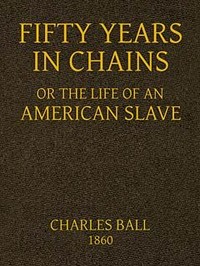
Fifty Years in Chains; or, the Life of an American Slave — A Reader’s Guide
(0 User reviews)
496
Project Gutenberg
2012
Not confirmed
African Americans -- Biography; Enslaved persons -- United States -- Biography; Ball, Charles, 1781?-; Slavery -- Maryland -- History; Slavery -- South Carolina -- History; Slavery -- Georgia -- History
Readers of public-domain and historical texts
Project Gutenberg digital edition
en
Edition facts
Words
109,425
Reading time
476 min
Text sections
9
The catalog record for Fifty Years in Chains; or, the Life of an American Slave — A Reader’s Guide provides practical reading context through 109,425 words, 7 hr 56 min estimated reading time, and 9 detected text sections.
The text analysis averages about 35.0 words per sentence, while the detected sections provide another way to judge how the source is divided.
Project Gutenberg metadata also associates the work with “African Americans -- Biography,” connecting these edition facts with the source record’s subject description.
Source:
Project Gutenberg record #40760
Charles Ball's narrative follows his fifty years enslaved across Maryland, South Carolina, and Georgia, detailing the separation from his mother, the theft of cotton by a fellow slave, and the constant threat of sale. The account is structured around specific episodes that reveal the daily mechanisms of bondage.
Read the complete public-domain text at its original source.
Read on Project GutenbergCharles Ball opens his narrative with a stark declaration: 'My story is a true one, and I shall tell it in a simple style.' That simplicity is deceptive. The book moves through a series of tightly focused scenes—the sale of a child, the work of a fishery, the theft of cotton—each rendered with precise, unadorned detail. Ball does not offer sweeping reflections; instead, he lets the weight of specific moments accumulate. The structure is episodic, shifting between plantations and states, yet held together by recurring images: chains, cotton, and the constant threat of separation.
Episodes of Separation and Sale
The narrative's first chapter establishes a pattern that will recur throughout: the breaking of families by sale. Ball describes his own sale at age four, when he was 'naked, never having had on clothes in my life.' His new master gave him a child's frock and took him on horseback, while his mother 'ran after me, took me down from the horse, clasped me in her arms, and wept loudly and bitterly.' This scene is not lingered upon; it is presented as a fact, a transaction. Later, Ball reports that his mother was sold to a Georgia trader, and he 'of all her children, was the only one left in Maryland.' The emotional weight is carried by the spareness of the telling. The reader is left to infer the cumulative effect of such losses, which Ball never explicitly moralizes.
The Cotton Theft and Its Aftermath
A central episode involves a fellow slave named Nero, who proposes stealing cotton from the plantation gin-house and selling it to a passing keel-boat. Ball recounts the scheme with careful attention to logistics: the dark night, the mule and cart, the bags of cotton hidden in a thicket of young pines. Nero's absence is explained to the other hands as a visit to his wife, and the theft goes undetected until morning. The overseer's response—threatening to 'whip every hand on the estate' to force a confession—reveals the collective punishment that governed slave life. Ball notes that the slaves suspected a free black man named Ishmael, while the overseer blamed a poor white receiver. The episode shows how suspicion and accusation circulated within the system, and how slaves navigated the danger of being implicated.
Movement Between Plantations and States
Ball's narrative is structured by movement: from Maryland to Georgia, from plantation to fishery, from one master to another. These transitions are not merely geographical; they mark shifts in labor, social relations, and the threat of violence. The fishery scene, for example, describes the work of laying out a seine at night, the arrival of the keel-boat, and the routine of hauling fish. But this setting also becomes the backdrop for the cotton theft, showing how the same location could serve both subsistence and subversion. Ball's account of the 'poor white man' living in a cabin of 'small poles of the yellow pine, with the bark remaining on them' offers a glimpse of the broader economy in which slaves, poor whites, and free blacks were entangled. The narrative rarely stays still; each new location brings new risks and new strategies for survival.
Recurring Images of Confinement and Surveillance
Throughout the excerpts, certain images recur: chains, cotton, and the ever-present threat of discovery. The title itself—Fifty Years in Chains—announces the central metaphor, but the text grounds it in physical details. Ball describes being 'naked' at sale, the 'child's frock' given by his master, the 'light-wood' Nero carries to explain his absence. These objects are never symbolic; they are the stuff of daily life. Yet they accumulate into a picture of constant surveillance: the overseer who 'discovered that some one had stolen two bags of cotton,' the examination of all hands, the threat of whipping. Ball's style—plain, factual, almost reportorial—mirrors the relentless scrutiny he endured. The reader is left to piece together the emotional reality from the concrete details.
Ball's narrative resists easy summary. It is not a linear autobiography but a series of vignettes, each chosen for its power to illustrate the mechanisms of slavery. Readers should attend to the small details—the bark on a pine pole, the weight of a cotton bag, the sound of a mother's weeping—for it is in these that the full weight of the story resides. The book demands patience and attention, rewarding those who read slowly and let the scenes speak for themselves.
Charles Ball’s fifty years move from one stolen day to the next, each sale a quiet rupture. I finished his guide and found myself thinking of Nat Love, whose The Life and Adventures of Nat Love Better Known in the Cattle Country as "Deadwood Dick" — Text and Context trades shackles for a saddle. Both men kept living, somehow, past what was taken. I just sat with that for a while.
There are no reviews for this eBook.
There are no comments for this eBook.
Reader reflection
Record your reading impressions
A brief reflection can help important ideas stay with you longer.
Your progress
0
/
10
2
How did the book work for you overall?
3
Is this a title you would suggest to others?
4
How easy was the book to follow?
5
Could you see yourself revisiting this book?
6
Which part made the strongest impression?
7
How much did the book move you?
8
Would you like to discuss this book with someone?
9
In one sentence, what did you learn?
10