1

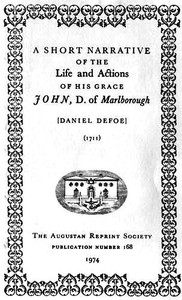
A Short Narrative of the Life and Actions of His Grace John, D. of Marlborogh — Key Ideas to Explore
(0 User reviews)
2520
Project Gutenberg
2011
Not confirmed
Generals -- Great Britain -- Biography; Statesmen -- Great Britain -- Biography; Marlborough, John Churchill, Duke of, 1650-1722; Great Britain -- Court and courtiers -- Biography
Readers of public-domain and historical texts
Project Gutenberg digital edition
en
Edition facts
Words
19,673
Reading time
86 min
Text sections
2
The source record for A Short Narrative of the Life and Actions of His Grace John, D. of Marlborogh — Key Ideas to Explore measures this digital text at 19,673 words, 1 hr 26 min estimated reading time, and 2 detected text sections.
The text analysis averages about 32.5 words per sentence, while the detected sections provide another way to judge how the source is divided.
Project Gutenberg metadata also associates the work with “Generals -- Great Britain -- Biography,” connecting these edition facts with the source record’s subject description.
Source:
Project Gutenberg record #37505
Defoe's 1711 pamphlet defends Marlborough against political attacks, contrasting his military triumphs with courtly ingratitude. The narrative weaves specific battle accounts with a broader argument about envy's power over public figures, using Raleigh as a historical parallel.
Read the complete public-domain text at its original source.
Read on Project GutenbergDefoe's 1711 pamphlet opens with a striking contrast: Marlborough's battlefield successes—his 'wonderful and conquering March to the Banks of the Danube' and his artful outmaneuvering of French marshals—are set against the 'scandalous Reflections' and 'undervalued and slighted' treatment he receives at home. The text immediately establishes a tension between military glory and political vulnerability, a pattern that recurs throughout.
The narrative voice is defensive and combative, addressing 'the common People of the Nation' directly. Defoe frames his project as exposing false reports, yet the excerpts reveal a more complex rhetorical strategy: he simultaneously celebrates Marlborough's achievements and warns that 'cunning Envy' can 'blow down the most lofty Cedar.' This dual focus on praise and persecution gives the pamphlet its distinctive energy.
The Rhetoric of Contrast: Glory and Ingratitude
Defoe repeatedly juxtaposes Marlborough's European renown with domestic disparagement. He notes that foreign ladies at court esteem the Duchess as 'one of the best bred Women of her Age,' while at home 'they give her Name very poor Quarters.' This pattern extends to the Duke: his victories are 'fresh in the Memory of every good Subject,' yet he is 'undervalued and slighted' upon return. The text uses these contrasts to build a case that Marlborough's virtues themselves provoke attack—'fair Marks set up on high for Envy to shoot at.'
The pamphlet's structure reinforces this tension. Defoe lists Marlborough's achievements—beating 'each one of the French Great Mareschalls round in their Turns'—before pivoting to the 'scandalous Reflections' that circulate. By placing the accusations after the triumphs, he makes ingratitude seem all the more unreasonable. The reader is left to wonder whether any military success could ever satisfy Marlborough's critics.
Historical Precedent and the Burden of Proof
Defoe invokes Sir Walter Raleigh as a 'remarkable Sharer' in a 'long Roll of Glorious Sufferers,' drawing a direct line from ancient examples to Marlborough's present predicament. This historical framing serves two purposes: it normalizes Marlborough's persecution as a recurring pattern, and it implicitly warns that the Duke's fate could mirror Raleigh's tragic end. The reference is carefully chosen—Raleigh was a military man and courtier who fell from favor, executed under James I.
The pamphlet then addresses specific charges, such as the claim that Marlborough 'avoided several Opportunities of Fighting' to prolong the war for personal gain. Defoe counters by shifting responsibility to 'his Monarch' and the allied powers, arguing that peace depends on the enemy's sincerity. This defensive strategy reveals the pamphlet's core argument: Marlborough is a scapegoat for broader political failures. The text does not, however, provide evidence for the sincerity of French negotiations; it relies on assertion rather than documentation.
The Language of Envy and the Public Sphere
Defoe's vocabulary is saturated with images of poison, blasts, and marksmanship. Envy shoots 'poysonous Darts'; its devices are 'effectually spread in the Mouths of the Multitude' and produce 'a Blast able to blow down the most lofty Cedar.' This metaphorical language transforms political opposition into a natural force, almost elemental in its destructiveness. The pamphlet thus presents itself as an antidote, aiming to 'let them see' the falseness of the reflections.
The text also reveals assumptions about public opinion. Defoe addresses 'the common People' as both the target of slander and the ultimate audience for his defense. He assumes that rational men, once shown the evidence, will recognize the malice. Yet the pamphlet's defensive tone suggests anxiety that reason alone may not prevail. The repeated emphasis on 'false, unreasonable, and malicious' reports implies a fear that slander, once 'spread,' is difficult to counteract. This tension between Enlightenment faith in reason and the reality of political manipulation gives the pamphlet a modern resonance.
Readers should attend to the pamphlet's rhetorical strategies rather than expecting a neutral biography. Defoe's use of contrast, historical analogy, and vivid metaphor reveals as much about early eighteenth-century political culture as about Marlborough himself. The text is best approached as a partisan intervention in a specific controversy, not a comprehensive life. Noticing how Defoe frames accusations and defenses—and what evidence he omits—will deepen understanding of both the Duke's contested reputation and the pamphlet's persuasive aims.
I keep thinking about how Defoe watched Marlborough get torn apart by envy, even after everything he’d done. It’s a lonely feeling, that. Then I remembered The Martyrs of Science, or, The lives of Galileo, Tycho Brahe, and Kepler — Text and Context — those men knew the same cold wind. The Martyrs of Science, or, The lives of Galileo, Tycho Brahe, and Kepler — Text and Context sits with you that way, quietly, like a shared ache over how brilliance gets punished.
There are no reviews for this eBook.
There are no comments for this eBook.
Reader reflection
Before you leave, reflect on the book
Use these questions to collect your thoughts before moving on.
Your progress
0
/
10
2
How much did you enjoy the reading experience?
3
Would you encourage someone else to read it?
4
Did the language feel accessible?
5
Would you start a conversation about this book?
6
What did you appreciate most?
7
How much did the book move you?
8
Could you see yourself revisiting this book?
9
What did this book teach you most?
10