
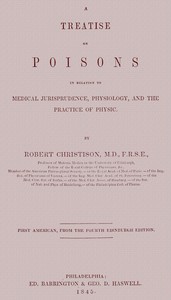
Treatise on Poisons by Sir Robert Christison
Let's be clear: Treatise on Poisons is not a novel. There's no protagonist, unless you count Christison himself, the brilliant and meticulous Scottish doctor guiding us through a gallery of grim substances. Published in 1829, this book was a landmark. It systematically organized everything known about poisons at the time. Christison didn't just list them; he explained where they came from, how they worked in the body, what the symptoms looked like, and—crucially—how to detect them after death.
The Story
There's no plot in the traditional sense. The 'story' is the journey of scientific discovery and the battle against hidden violence. Christison walks us through mineral poisons like arsenic (a favorite of Victorian murderers), moves on to potent plant toxins like hemlock and opium, and even covers animal venoms and 'gaseous poisons.' Each section is a mix of chemistry, case studies from his own practice or famous trials, and practical advice for doctors. The narrative tension comes from the real-world stakes: this knowledge could save a life, convict a killer, or prevent an accidental death.
Why You Should Read It
I loved this book for its strange, macabre practicality. You get a real sense of the dangers of everyday life in the 1800s. It’s also surprisingly human. Christison's voice comes through—he’s clearly frustrated by quack antidotes, fascinated by bizarre symptoms, and driven by a desire to bring order to a chaotic field. Reading his careful descriptions of how arsenic tastes (metallic) or how a strychnine victim's body contorts makes history feel immediate and visceral. It connects the dots between science, law, and the classic 'whodunit' in a way few books can.
Final Verdict
This is a niche read, but a rewarding one. It's perfect for history buffs, true crime enthusiasts, and fans of Sherlock Holmes-style detective stories who want to understand the real science behind the fiction. If you enjoy books like The Poisoner's Handbook or are fascinated by the history of medicine, Christison's Treatise is a foundational text that's more accessible and engaging than you might think. Steer clear if you're looking for a light narrative, but if you're curious about the dark underpinnings of the 19th century, this is a fascinating deep dive.
This title is part of the public domain archive. It serves as a testament to our shared literary heritage.
Emily Williams
5 months agoI've been looking for a reliable source on this topic, and the logic behind each conclusion is easy to follow and verify. I am looking forward to the author's next publication.
Susan Wilson
1 year agoThe balance between academic rigor and readability is perfect.
Mary Moore
1 year agoHaving explored several resources on this, I find that the logic behind each conclusion is easy to follow and verify. An excellent example of how quality digital books should be formatted.
Donald Gonzalez
4 months agoThis digital copy caught my eye due to its reputation, it addresses the common misconceptions in a very professional manner. It’s a comprehensive resource that doesn't feel bloated.



Karen Smith
2 months agoThe balance between academic rigor and readability is perfect.