
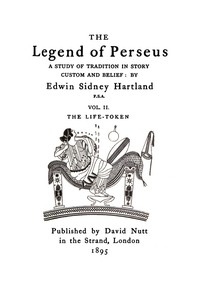
The legend of Perseus, Volume 2 (of 3) : The life-token by Edwin Sidney Hartland
Edwin Sidney Hartland's The Life-Token is the second act in his deep dive into the Perseus legend, but it quickly becomes clear this isn't a simple novel. Hartland was a folklorist, and his mission was to trace the roots of our oldest stories.
The Story
The book uses the familiar myth of Perseus more as a launching pad than a strict script. The core of the volume is the concept of the "life-token" or "life-index." This is the idea that a person's soul or vitality is tied to an external object—like a tree that grows with them, a lamp whose flame represents their life, or a stone that cracks when they are in danger. Hartland shows how this motif isn't just a quirky detail in the Perseus saga (where it sometimes appears linked to his grandfather, King Acrisius), but a storytelling device found globally. He collects and compares examples from European fairy tales, Indian epics, and Celtic lore, building a fascinating case for how ancient people understood life, death, and destiny through these symbolic links.
Why You Should Read It
What's truly captivating is the detective work. Reading this feels like joining Hartland on a treasure hunt through world mythology. Each chapter presents a new variant of the life-token story, and you start making connections yourself. It's not dry analysis; it's the thrill of recognition. You'll read a snippet from a Russian folktale and gasp because you just saw the same pattern in a story from Japan. Hartland's passion is contagious. He makes you see the Perseus myth not as a standalone Greek story, but as one beautiful, complex piece in a massive, global puzzle about human fears and hopes. The "character" that shines the most is this persistent, universal idea itself—our ancestors' need to symbolize the fragile, magical nature of life.
Final Verdict
This isn't for someone looking for a fast-paced fantasy adventure. It's a book for the curious. Perfect for mythology fans who want to go beyond the summaries and see how the stories work under the hood. It's also a great pick for writers and creators looking for ancient, powerful narrative devices. If you enjoy connecting dots and seeing the bigger picture in our shared cultural history, you'll find The Life-Token absolutely absorbing. Just be warned: you'll never hear a fairy tale the same way again.
You are viewing a work that belongs to the global public domain. Thank you for supporting open literature.
James Rodriguez
5 months agoThis is an essential addition to any academic digital library.
David Anderson
7 months agoInitially, I was looking for a specific answer, but the cross-referencing of different chapters makes it a great study tool. It’s hard to find this much value in a single source these days.
Elizabeth Gonzalez
1 year agoIf you're tired of surface-level information, the wealth of information provided exceeds the average market standard. This exceeded my expectations in almost every way.
Donald Gonzalez
4 months agoRight from the opening paragraph, the narrative arc keeps the reader engaged while delivering factual content. It’s hard to find this much value in a single source these days.

Matthew Jackson
1 year agoI stumbled upon this title during my weekend research and the emphasis on ethics and sustainability within the topic is commendable. Definitely a five-star contribution to the field.