1

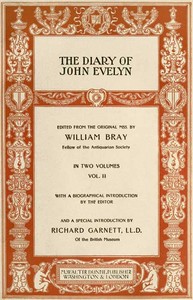
The Diary of John Evelyn (Volume 2 of 2) — A Reader’s Guide
(0 User reviews)
57
Project Gutenberg
2013
Not confirmed
Great Britain -- History -- Stuarts, 1603-1714; Great Britain -- Court and courtiers -- Early works to 1800; Evelyn, John, 1620-1706 -- Diaries; Great Britain -- Social life and customs -- Early works to 1800
Readers of public-domain and historical texts
Project Gutenberg digital edition
en
Edition facts
Words
145,146
Reading time
632 min
Text sections
19
The Diary of John Evelyn (Volume 2 of 2) — A Reader’s Guide can be approached with a clearer sense of reading commitment from its source measurements: 145,146 words, 10 hr 32 min estimated reading time, and 19 detected text sections.
The text analysis averages about 20.4 words per sentence, while the detected sections provide another way to judge how the source is divided.
Project Gutenberg metadata also associates the work with “Great Britain -- History -- Stuarts, 1603-1714,” connecting these edition facts with the source record’s subject description.
Source:
Project Gutenberg record #42081
John Evelyn's diary entries from 1665 to 1706 document his public commissions, personal observations of extreme weather, and interactions with notable figures, offering a firsthand account of Restoration England beyond court politics.
Read the complete public-domain text at its original source.
Read on Project GutenbergJohn Evelyn's diary entries for February 1684 describe a severe frost that froze the Thames, turning it into a carnival ground with coaches, sleds, and puppet-plays, while simultaneously causing widespread destruction: trees split, men and cattle perished, and London's coal smoke became so thick it obstructed breathing. This juxtaposition of festivity and disaster is characteristic of Evelyn's observational style, which blends administrative detail with vivid natural description.
Volume 2 covers 1665 to 1706, a period in which Evelyn served as a commissioner for sick and wounded seamen, traveled to Kent to settle officers, and recorded the aftermath of the Popish Plot. His entries are terse but packed with specific names, places, and sums, reflecting a mind attuned to both public duty and private curiosity.
Commissioner in the Field
Evelyn's role as a commissioner for sick and wounded seamen is documented in the opening entries of 1665. He traveled to Dover and other Kent ports, delivering the Privy Council's letter to the Mayor of Rochester and settling deputies. The diary records precise logistics: he lodged at Dover Castle, was treated by Colonel Stroode, and found the cathedral at Canterbury “exceedingly well repaired since his Majesty's return.” These details reveal Evelyn as a hands-on administrator, not merely a court observer.
The catalog subject “Great Britain -- Court and courtiers” suggests a focus on court life, but the excerpts show Evelyn operating far from court, in coastal towns, managing practical affairs. His diary entries are often more concerned with infrastructure and public health than with royal intrigue.
The Great Frost of 1684
The frost of January–February 1684 is described in extraordinary detail. Evelyn notes that the Thames froze so solid that “coaches plied from Westminster to the Temple” and booths were erected for sports and pastimes. Yet he immediately counters this carnival image with the devastation: trees splitting, men and cattle perishing, exotic plants dying, and London's coal smoke causing breathing difficulties. He records that the frost extended across Europe, even to Spain.
Evelyn's garden at Sayes Court suffered: oranges and myrtles were “very sick,” rosemary and laurels appeared dead, though cypress endured. This personal loss grounds the grand weather event in domestic reality. The diary also notes that a copper engraving was made to memorialize the frost fair, showing Evelyn's awareness of historical record-keeping.
Networks of Knowledge and Power
Evelyn's entries for February 1684 show him moving among influential figures. He dined with Lord Keeper North, discussing music and painting; visited the virtuoso Monsieur Justell; and assisted Dr. Tenison with plans for a public library in St. Martin's parish, consulting Sir Christopher Wren on its structure. These interactions reveal Evelyn's role as a connector of intellectual and political circles.
The catalog subject “Great Britain -- Social life and customs” is evident here, but the excerpts emphasize purposeful sociability—discussions of architecture, music, and library design—rather than mere entertainment. Evelyn also records news of the Earl of Danby's release on bail and the trial of Mr. Hampden, linking his personal network to national events.
Readers should approach this volume as a selective record, not a comprehensive history. Evelyn omits many events and focuses on what he witnessed or participated in directly. The diary's strength lies in its concrete details—the cost of printing, the condition of plants, the names of officials—which provide a granular view of Restoration life. Pay attention to what Evelyn chooses to record and what he passes over silently.
That rainy afternoon, Evelyn’s sharp entries on the Great Fire and its smoky aftermath lingered. Leafing through his careful, official tone made me ache for something more intimate, more immediate. His precise records felt like walls; I wanted a window. I found one in Diary of Samuel Pepys — Volume 18: September/October 1662 — Context and Discussion, his smaller worries surprisingly more human beside Evelyn’s grander scope.
There are no reviews for this eBook.
There are no comments for this eBook.
Reader reflection
Record your reading impressions
A brief reflection can help important ideas stay with you longer.
Your progress
0
/
10
2
How much did you enjoy the reading experience?
3
Would you recommend this book to another reader?
4
Did the language feel accessible?
5
Did any part of the book feel personally relevant?
6
How valuable was this book for your own interests?
7
Would a second reading be valuable?
8
How well did it match your expectations?
9
What is the main idea you are taking away?
10