1

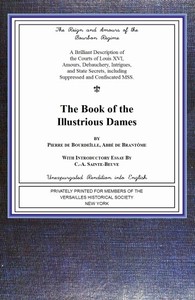
The book of the ladies Illustrious Dames: The Reign and Amours of the Bourbon Régime — Themes and Context
(0 User reviews)
59
Project Gutenberg
2013
Not confirmed
France -- Court and courtiers; Women -- Biography; France -- Biography; Queens
Readers of public-domain and historical texts
Project Gutenberg digital edition
en
Edition facts
Words
104,934
Reading time
457 min
Text sections
11
This digital edition of The book of the ladies Illustrious Dames: The Reign and Amours of the Bourbon Régime — Themes and Context is described by source-level measurements including 104,934 words, 7 hr 37 min estimated reading time, and 11 detected text sections.
The text analysis averages about 32.2 words per sentence, while the detected sections provide another way to judge how the source is divided.
Project Gutenberg metadata also associates the work with “France -- Court and courtiers,” connecting these edition facts with the source record’s subject description.
Source:
Project Gutenberg record #42515
Brantôme's firsthand observations of French queens and noblewomen, blending court gossip with detailed descriptions of dress and beauty, as seen in excerpts about Marguerite de Valois.
Read the complete public-domain text at its original source.
Read on Project GutenbergBrantôme's account of Marguerite de Valois at a fête at the Tuileries offers a vivid example of his method: he describes her gown of Spanish rose velvet covered with spangles, a cap with plumes and jewels, and claims her beauty outshone the king's harangue at the States-general. His narrative weaves personal recollection with reported praise, noting that over three hundred spectators found her appearance more instructive than the king's speech. The passage reveals how Brantôme prioritizes visual spectacle and courtly admiration over political events, treating the queen's attire as a subject worthy of sustained analysis.
Dress as a Window onto Court Values
The excerpt on Marguerite de Valois demonstrates that Brantôme uses clothing not merely as ornament but as evidence of character and social standing. He catalogs fabrics, colors, and accessories—Spanish rose velvet, spangles, tan crêpe veils—and records how courtiers debated which attire became her most. When he describes her natural hair versus perukes, he frames the choice as a contest between nature and artifice, concluding that nature surpasses all artifice. Yet he notes she preferred perukes, suggesting a tension between ideal and practice. This attention to material detail aligns with the catalog subject "France -- Court and courtiers," but the excerpts show Brantôme's interest is less in institutional structure than in the sensory experience of court life.
The Narrator as Eyewitness and Poet
Brantôme positions himself as a participant in the scenes he recounts. He reports telling the poet Ronsard that Marguerite resembled Aurora, and that Ronsard later composed a sonnet based on the comparison. This anecdote does more than flatter the queen; it establishes Brantôme's own role as a connoisseur of beauty and a catalyst for art. He also records a gentleman's remark that seeing the princess daily was like living in a terrestrial paradise. Such reported speech gives the narrative an oral, conversational quality, as if the reader is overhearing court gossip. The catalog lists Brantôme as author of memoirs, and the excerpts confirm that his authority rests on having been present, not on archival research.
Beauty as a Political Force
Brantôme claims that Marguerite's appearance at the States-general diverted attention from the king's speech, implying that her beauty had political weight. He describes her orange and black robe with spangles and her veil of ceremony, then states that three hundred listeners were "better instructed and delighted" by contemplating her than by hearing the king. This assertion blurs the line between aesthetic admiration and political commentary. The catalog subject "Queens" might lead a reader to expect discussions of governance, but the excerpts focus on how queens were perceived as visual spectacles. Brantôme's emphasis on the queen's throat and bosom, and on ladies being permitted to kiss her, suggests that physical beauty was a form of currency at court, subject to public evaluation and envy.
Readers should approach Brantôme's text as a series of set pieces rather than a systematic history. His digressions—such as the comparison to Roman emperors—reveal a mind that moves from specific observation to classical analogy. The excerpts do not provide a complete portrait of any queen, but they show how Brantôme constructs authority through eyewitness claims and reported conversations. Pay attention to his asides and comparisons, which often carry more weight than the main narrative.
I keep thinking about Brantôme's Illustrious Dames — how he just listens to women talk, notes their gowns and grudges, and lets them stay human. It reminded me of picking up Slave Narratives: A Folk History of Slavery in the United States from Interviews with Former Slaves, Volume IX, Mississippi Narratives — Background and Themes. Different worlds entirely, but both feel like someone pressing a warm hand to your arm, saying, this is what they remembered, and it mattered.
There are no reviews for this eBook.
There are no comments for this eBook.
Reader reflection
Record your reading impressions
A brief reflection can help important ideas stay with you longer.
Your progress
0
/
10
2
How much did you enjoy the reading experience?
3
Would you encourage someone else to read it?
4
Did the language feel accessible?
5
Did the book meet your expectations?
6
Did it raise ideas you would like to talk about?
7
How would you rate its originality?
8
What did you think about the pace?
9
What is the main idea you are taking away?
10