
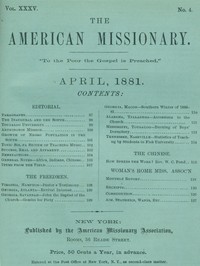
The American Missionary — Volume 35, No. 4, April, 1881 by Various
Forget everything you know about a standard book. 'The American Missionary — Volume 35, No. 4, April, 1881' is a primary source, a monthly periodical published by the American Missionary Association (AMA). Reading it is less like following a story and more like opening a filing cabinet from 1881 and sifting through the reports, letters, and financial statements of a massive social project.
The Story
There's no single narrative. Instead, the 'plot' is the ongoing work of the AMA in the post-Civil War South. This issue is a snapshot of that work in April 1881. You'll find detailed lists of donations (often just a few dollars from church congregations), budgets for schools, and obituaries for missionaries. The real heart, though, is in the letters from the field. Teachers and principals stationed in places like Georgia, Tennessee, and Alabama write back to the headquarters. They talk about student progress, describe building new schoolhouses, and frankly discuss the challenges: lack of books, hostile local attitudes, and the sheer difficulty of their mission. The 'conflict' is their daily reality.
Why You Should Read It
This is history without the polish. Textbooks tell us about Reconstruction; this magazine shows it. What struck me was the blend of deep religious conviction and practical, boots-on-the-ground problem solving. These weren't distant figures; they were people worried about roof repairs and student attendance. Reading their direct words—their hopes, their frustrations, their appeals for more funding—erases over a century of distance. You feel the weight of their task and the sincerity of their effort. It's a powerful reminder that big historical changes are made up of countless small, difficult actions.
Final Verdict
This isn't for someone looking for a light historical novel. It's a specialist's treasure and a curious reader's deep dive. Perfect for history buffs, students of Reconstruction or African American history, and anyone who loves unvarnished primary sources. If you enjoy the feeling of discovering raw documents and piecing the story together yourself, you'll be captivated. For the general reader, it's a challenging but incredibly rewarding look at the messy, human effort behind a pivotal chapter in American history.
There are no legal restrictions on this material. Preserving history for future generations.
Matthew Lopez
3 months agoComparing this to other titles in the same genre, the wealth of information provided exceeds the average market standard. This has become my go-to guide for this specific topic.
David White
6 months agoAs a professional in this niche, the author clearly has a deep mastery of the subject matter. This exceeded my expectations in almost every way.
Kimberly Gonzalez
3 months agoI found the author's tone to be very professional yet accessible, the cross-referencing of different chapters makes it a great study tool. Simple, effective, and authoritative – what else could you ask for?
Sarah Lopez
11 months agoI started reading this with a critical mind, the historical context mentioned in the early chapters is quite enlightening. A refreshing and intellectually stimulating read.



Matthew Gonzalez
1 year agoThe methodology used in this work is academically sound.