
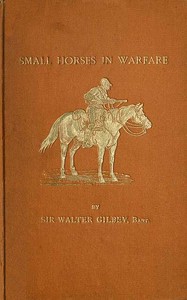
Small Horses in Warfare by Sir Walter Gilbey
Forget everything you think you know about knights in shining armor. Sir Walter Gilbey's Small Horses in Warfare isn't a story about kings or battles. It's a story about logistics, economics, and the four-legged engines that made medieval armies move. Gilbey, writing in the early 1900s, uses his deep knowledge as a horse breeder to challenge a popular myth: that medieval warfare was fought exclusively on the backs of enormous, plated warhorses.
The Story
There isn't a traditional plot here. Instead, Gilbey builds his case like a lawyer presenting evidence. He scours historical documents—army supply lists, records of what horses cost, descriptions from chroniclers—to show that most soldiers, including many knights, rode horses we would consider ponies by today's standards. He points out that large horses were incredibly expensive to buy and feed, and were often too fragile for the muddy, grueling conditions of campaign life. The real backbone of the cavalry, he argues, was the smaller, tougher, and more affordable 'rouncey' or similar type, standing maybe 14 hands high. The book is his collection of proof, pulling examples from the Crusades to the Hundred Years' War to prove his point.
Why You Should Read It
This book is a masterclass in looking at history from a different angle. Gilbey makes you reconsider the practical realities of the past. It’s not about glorious charges, but about how an army actually functioned—what it could afford, what could survive a winter siege, and what kind of animal could carry a man in armor for months on end. You start to see history through the lens of a quartermaster, not a king. It’s surprisingly gripping in a quiet, scholarly way. You find yourself nodding along as he picks apart a famous painting or questions a chronicler's boastful account, all in service of giving the humble, hardy small horse its due.
Final Verdict
This is a niche gem, but a brilliant one. It's perfect for history buffs who enjoy micro-histories or anyone fascinated by the everyday mechanics of the past. If you love military history, this adds a crucial, often-overlooked layer. It’s also great for horse people interested in historical breeds. The writing is old-fashioned but clear, and it’s short enough to digest in an afternoon. Just don't expect swashbuckling adventure—the thrill here is in the quiet dismantling of a long-held assumption, one historical receipt at a time.
This publication is available for unrestricted use. You do not need permission to reproduce this work.
Paul Moore
6 months agoIf you enjoy this genre, the storytelling feels authentic and emotionally grounded. Highly recommended.
Donna Perez
1 year agoUsed this for my thesis, incredibly useful.
Charles Perez
1 year agoNot bad at all.
Matthew Taylor
1 year agoTo be perfectly clear, it creates a vivid world that you simply do not want to leave. Thanks for sharing this review.







Elizabeth Flores
3 months agoRead this on my tablet, looks great.