1

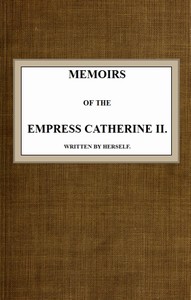
Memoirs of the Empress Catherine II. Written by Herself — Edition Insights
(0 User reviews)
546
Project Gutenberg
2014
Not confirmed
Catherine II, Empress of Russia, 1729-1796; Empresses -- Russia -- Biography; Russia -- History -- Catherine II, 1762-1796
Readers of public-domain and historical texts
Project Gutenberg digital edition
en
Edition facts
Words
103,684
Reading time
451 min
Text sections
8
The source record for Memoirs of the Empress Catherine II. Written by Herself — Edition Insights measures this digital text at 103,684 words, 7 hr 31 min estimated reading time, and 8 detected text sections.
The text analysis averages about 24.8 words per sentence, while the detected sections provide another way to judge how the source is divided.
Project Gutenberg metadata also associates the work with “Catherine II, Empress of Russia, 1729-1796,” connecting these edition facts with the source record’s subject description.
Source:
Project Gutenberg record #46407
Catherine the Great's own account of her early years at the Russian court, structured in two parts (1744 and 1752–1759), with a preface detailing the manuscript's secret history. The narrative moves between intimate conversations and formal ceremonies, revealing her careful navigation of imperial politics.
Read the complete public-domain text at its original source.
Read on Project GutenbergCatherine's memoirs open not with her birth but with a preface by A. Herzen that traces the manuscript's clandestine journey from a sealed envelope addressed to her son Paul to copies made by Prince Kourakine, the poet Pushkin, and others, before being locked in the imperial archives. The narrative itself begins in 1744, when the future empress arrives in Russia as a young German princess. The structure is starkly divided: Part I covers that single year, while Part II spans 1752 to 1759, with each year given its own section. This chronological framing is punctuated by set-piece descriptions of court ceremonies—coronation anniversaries, state dinners, and religious observances—that contrast sharply with the private, often tense conversations she records.
A Manuscript Under Seal
The preface establishes the memoir as a politically charged document. Herzen recounts how Catherine sealed the manuscript with an inscription to her son Paul, who kept it secret, sharing it only with Prince Alexander Kourakine. After Paul's death, copies circulated among nobles until Emperor Nicholas ordered the Secret Police to seize them—including one written by Pushkin. The original was then sealed with the great seal of state and placed in the imperial archives. This framing alerts the reader that the text was never intended for public circulation during Catherine's lifetime, and its survival involved a chain of trusted intermediaries.
The Empress's Displeasure at Mass
A key episode illustrates Catherine's vulnerability to imperial whim. During the anniversary of Elizabeth's coronation, Catherine describes being "quite blue, and frozen" in the cold cathedral, wearing only a court dress. The Empress sends word to put on a sable tippet, but Catherine has none. Elizabeth then brings her own tippet, puts it on her own neck, and ignores another in the box that Catherine expects to receive. Catherine interprets this as "a pretty evident sign of displeasure." The public slight continues when Elizabeth dines alone on the throne, excluding Catherine and her husband, who must return home "benumbed with cold and dying of hunger" after a fourteen-verste carriage ride. The passage reveals how ceremonial protocol could be weaponized to convey favor or disfavor.
A Conversation About Preference
In a remarkable scene, Madame Tchoglokoff—the court official responsible for Catherine's conduct—initiates a long preamble about marital attachment and "what was necessary for ensuring mutual love." She then abruptly offers Catherine a choice between two men: Sergius Soltikoff and Leon Narichkine. Catherine plays "the simpleton," denying any preference, but Tchoglokoff insists, saying, "if it be not Narichkine, it is Soltikoff." Catherine's silence is taken as confirmation. The episode is striking for its directness: a senior courtier openly facilitates an extramarital liaison, framing it as a matter of state interest. Catherine's narrative voice remains guarded, recording her own astonishment and uncertainty about whether it was "a snare."
Movement Between Town and Country
The memoirs repeatedly trace journeys between Moscow residences—the wooden palace at the Sloboda, the Kremlin, and the country estate at Liberitza. These movements are not merely geographical but mark shifts in court dynamics. After Easter, the court moves to the country, where Catherine notes that Elizabeth scolded her "several times" for her apparent naivety. The distances are measured precisely: fourteen or fifteen verstes from Moscow to Liberitza, seven verstes through the city to the cathedral. The physical cold of the church and the hunger of the return journey become metaphors for Catherine's precarious position. The narrative's rhythm—alternating between intimate conversations and elaborate public ceremonies—mirrors the dual life Catherine had to navigate as both a private individual and a political figure.
Readers should attend to the gaps in this memoir: it breaks off abruptly near the end of 1759, before Catherine's accession. The preface hints at detached notes that may have been burned by Paul. What remains is a carefully constructed self-portrait from the years when Catherine was still Grand Duchess, maneuvering within a court where every gesture—a tippet offered or withheld, a dinner invitation granted or denied—carried political weight. The text rewards attention to its silences and its strategic revelations.
I keep thinking about Catherine’s quiet arithmetic—every glance, every word weighed in the amber of court ceremony. Her loneliness inside all that formality stayed with me. It reminded me of how Drake’s Great Armada feels like watching someone steer through a storm, alone at the helm. Both are about the private cost of public composure. Drake's Great Armada — Key Ideas to Explore
There are no reviews for this eBook.
There are no comments for this eBook.
Reader reflection
Take a moment to reflect on this book
Create a short personal record of your experience with this book.
Your progress
0
/
10
2
Did this book hold your interest?
3
Is this a title you would suggest to others?
4
How demanding did the text feel?
5
Did you gain anything practical from the text?
6
How personally connected did you feel to the book?
7
Would a second reading be valuable?
8
Which element worked best for you?
9
What is the main idea you are taking away?
10