1

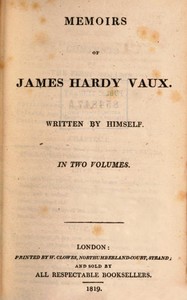
Memoirs of James Hardy Vaux. Written by himself. — A Reader’s Guide
(0 User reviews)
123
Project Gutenberg
2024
Not confirmed
Criminals -- England -- Biography; Vaux, James Hardy, 1782-; Thieves -- England -- Biography; Thieves -- Australia -- New South Wales -- Biography; Cant -- Glossaries, vocabularies, etc.; Flash (Prisoners' dialect) -- Glossaries, vocabularies, etc.; English language -- Great Britain -- Slang -- Glossaries, vocabularies, etc.; Rogues and vagabonds -- Great Britain -- Language -- Glossaries, vocabularies, etc.
Readers of public-domain and historical texts
Project Gutenberg digital edition
en
Edition facts
Words
120,308
Reading time
524 min
Text sections
43
This digital edition of Memoirs of James Hardy Vaux. Written by himself. — A Reader’s Guide is described by source-level measurements including 120,308 words, 8 hr 44 min estimated reading time, and 43 detected text sections.
The text analysis averages about 29.1 words per sentence, while the detected sections provide another way to judge how the source is divided.
Project Gutenberg metadata also associates the work with “Criminals -- England -- Biography,” connecting these edition facts with the source record’s subject description.
Source:
Project Gutenberg record #73187
James Hardy Vaux's 1819 memoir recounts his life as a thief, convict, and transported felon, blending picaresque adventure with a glossary of criminal slang. The narrative details his escapes, deceptions, and repeated returns to crime, offering a firsthand view of early 19th-century underworld life in England and Australia.
Read the complete public-domain text at its original source.
Read on Project GutenbergJames Hardy Vaux opens his memoir with a detailed account of his family background and early childhood, but the narrative quickly accelerates into a series of scrapes, deceptions, and narrow escapes. The excerpt from his time as a midshipman on a frigate anchored at Portsmouth illustrates his characteristic blend of audacity and anxiety: he persuades a sympathetic woman to smuggle his civilian clothes ashore, then talks his way past the commanding officer to join the liberty-men, all while trembling inwardly. The scene is rich with specific detail—the red flannel shirt and tarry trousers he wears to avoid suspicion, the half-guinea pressed on him by the purser, and the officer's wry warning about sending marines after him. Vaux's voice is at once self-justifying and vividly concrete, making the reader complicit in his schemes.
The Art of the Escape
Vaux's memoir is structured around a recurring pattern: he gets into a tight spot, talks his way out, and then promptly resumes his old habits. The Portsmouth episode is a textbook example. Having deserted his ship for a woman, he finds himself trapped aboard a man-of-war, desperate to get ashore before the vessel sails. His method is meticulous: he cultivates a female vendor, entrusts her with a bundle of genteel clothes, and then, on the appointed Sunday, presents himself to the officers in his working dress. The negotiation with Mr. Oxley and Mr. Sherard is a small drama of manipulation—Vaux's trembling voice, the officer's hesitation, the unexpected gift of half-a-guinea. The scene ends with a second recall, a joke about marines, and Vaux's hurried instructions to a friend to salvage his belongings. This pattern—planning, performance, and flight—recurs throughout the memoir, each time with variations in setting and stakes.
A Vocabulary of the Underworld
One of the most distinctive features of Vaux's memoir is its glossary of cant and flash language, appended to the second volume. The catalog subjects list 'Cant — Glossaries, vocabularies, etc.' and 'Flash (Prisoners' dialect) — Glossaries, vocabularies, etc.', indicating that the work is as much a linguistic document as a personal narrative. Vaux uses terms like 'togs' for clothes and 'taking French leave' for desertion within the narrative itself, embedding the slang in context. The glossary, however, stands apart as a systematic record of the criminal slang of early 19th-century London and the Australian penal colonies. Readers interested in historical linguistics or the social world of thieves will find this appendix a valuable resource, though the memoir's main text also rewards attention to the way Vaux shifts between polite and flash registers depending on his audience.
The Double Life of a Convict Author
Vaux writes his memoir from the peculiar position of a man who has been transported to New South Wales, yet he addresses a respectable readership. The preface and dedication (mentioned in the table of contents) frame the work as a cautionary tale, but the narrative itself often revels in the cleverness of its roguery. The excerpt shows Vaux carefully managing his appearance—dressing down to avoid suspicion, preserving a 'genteel black coat' for his escape. This duality extends to his prose: he can describe a bribe or a bilking with the same precision he uses to recount a naval officer's joke. The tension between the repentant tone of the framing material and the energetic, amoral detail of the episodes is one of the memoir's enduring fascinations. Readers should attend to how Vaux navigates this contradiction, and consider whether the glossary itself serves as a kind of secret handshake between the author and those in the know.
Vaux's memoir is best approached as a hybrid work: part autobiography, part rogue's gallery, part slang dictionary. The narrative rewards close attention to its small set-pieces—the negotiation with an officer, the concealment of a bundle of clothes, the anxious wait for a boat. Readers may wish to read the glossary alongside the main text, noting how the cant terms surface in moments of crisis or camaraderie. The memoir offers no grand moral conclusions, but its accumulation of specific, practical details creates a vivid portrait of a life lived on the margins of the law.
Reading about Vaux’s restless dodging of consequence, I thought of my grandfather’s worn copy of the Suttner memoirs—her quiet defiance felt so different, yet both lives hinged on the ache of not belonging. That same hum of displacement surfaced in Memoirs of Bertha von Suttner: The Records of an Eventful Life (Vol. 1 of 2) — Themes and Context, though her battles were waged with words, not slips. Strange how two such worlds still echo each other.
There are no reviews for this eBook.
There are no comments for this eBook.
Reader reflection
Take a moment to reflect on this book
Create a short personal record of your experience with this book.
Your progress
0
/
10
2
Was reading this book enjoyable?
3
Is this a title you would suggest to others?
4
How much effort did this book require?
5
Which element worked best for you?
6
Was the book easy to understand?
7
How did the pace of the book feel?
8
How original did the book feel?
9
What did this book teach you most?
10