
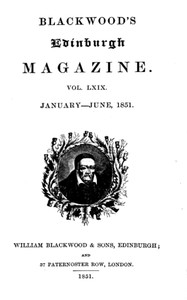
Blackwood's Edinburgh Magazine, Volume 69, No. 423, January 1851 by Various
This isn't a novel with a single plot, but a snapshot of a world in conversation with itself. Blackwood's Edinburgh Magazine was one of the most influential periodicals of its day, and this January 1851 issue lands right in the middle of a cultural earthquake: the lead-up to the Great Exhibition of the Works of Industry of All Nations. The 'story' here is the collective mood of Britain.
The Story
Imagine the buzz in London. In a few months, the Crystal Palace—a gigantic glass and iron structure—will open in Hyde Park, filled with machines, fabrics, and curiosities from across the globe. This issue captures the anticipation and the anxiety. You get essays debating the very soul of this new industrial age. There are vivid descriptions of the frantic construction, mixed with worries about foreign influence and the loss of old ways. Alongside this central theme, you'll find the magazine's usual mix: serialized fiction (often dark and suspenseful), political commentary, literary criticism, and even some poetry. It's a full, rich, and sometimes contradictory portrait of a society trying to figure out its future.
Why You Should Read It
What I love about this is the raw, unfiltered voice. History books tell us the Great Exhibition was a success. This magazine shows you the arguments happening at the dinner table before it even opened. The writers aren't distant historians; they're people living through the change, excited by the possibilities but genuinely worried about the pace. You feel their pride and their fear. Reading their debates about technology, art, and national identity is startlingly familiar. Swap 'steam engine' for 'artificial intelligence' and some of the conversations could happen today. It makes the Victorians feel less like stiff figures in portraits and more like neighbors grappling with a world that's moving too fast.
Final Verdict
Perfect for anyone who loves history but finds textbooks dry. If you enjoy podcasts or articles that explore the 'why' behind big cultural moments, you'll find this fascinating. It's also a goldmine for writers seeking authentic period atmosphere. It's not a light read—the language is of its time—but it's a deeply rewarding one. You don't just learn about 1851; you get to listen in on it.
You are viewing a work that belongs to the global public domain. You do not need permission to reproduce this work.
Christopher Lopez
9 months agoExactly what I was looking for, thanks!
Patricia Perez
2 years agoI found the data interpretation to be highly professional and unbiased.
Richard Jones
1 year agoI was particularly interested in the case studies mentioned here, the inclusion of diverse viewpoints strengthens the overall narrative. Definitely a five-star contribution to the field.
Donald Martinez
1 year agoI came across this while browsing and the atmosphere created is totally immersive. Absolutely essential reading.



James Thomas
2 years agoThe clarity of the concluding remarks is very professional.