
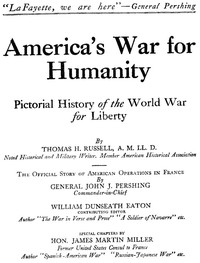
America's War for Humanity by Thomas Herbert Russell
Published in 1919, America's War for Humanity is a piece of history written in the moment. Thomas Herbert Russell crafts a detailed narrative of the United States' journey from reluctant observer to decisive participant in the First World War.
The Story
The book walks us through the critical years from 1914 to 1918. It starts with the war's outbreak in Europe and America's initial, firm stance of neutrality. Russell then traces the mounting pressures that changed everything: the shocking sinking of passenger ships like the Lusitania, the revelation of secret German plots, and the final push of unrestricted submarine warfare. We follow President Woodrow Wilson's struggle to keep peace, his heartfelt speeches to Congress, and the eventual, dramatic declaration of war. The narrative covers the rapid mobilization of a nation unprepared for a massive modern war—the drafting of an army, the industrial shift to support the Allies, and the brave journey of the American Expeditionary Forces to the trenches of France.
Why You Should Read It
What makes this book stand out is its perspective. This isn't a detached, modern analysis. It's a primary source, pulsing with the energy and conviction of its time. Russell doesn't hide his viewpoint; he proudly champions the Allied cause and America's role as a force for good. Reading his arguments for why the war was necessary—framed as a fight for civilization against barbarism—gives you a raw understanding of wartime propaganda and national sentiment. You get to see how history was being shaped and sold to the public before the dust had even settled. The language is grand and patriotic, which is itself a revealing window into the era's mindset.
Final Verdict
This book is perfect for history buffs who want to go beyond the facts and feel the atmosphere of a bygone era. It's especially valuable for anyone interested in World War I, early 20th-century America, or the power of media and narrative in shaping public opinion. Be prepared for a book of its time—its perspectives are dated and its conclusions are firm. But that's exactly its strength. Think of it less as the final word on the subject and more as a compelling, firsthand document that lets you listen in on a national conversation from a century ago. If you approach it with that curiosity, you'll find it absolutely absorbing.
This text is dedicated to the public domain. Share knowledge freely with the world.
John Moore
1 month agoExactly what I was looking for, thanks!
Richard Martinez
1 year agoIt took me a while to process the complex ideas here, but the narrative arc keeps the reader engaged while delivering factual content. A refreshing and intellectually stimulating read.
Donald Johnson
2 months agoI was skeptical about the depth of this book at first, but the wealth of information provided exceeds the average market standard. I appreciate the effort that went into this curation.
Jackson Lee
1 year agoGreat reference material for my coursework.





Karen Moore
2 years agoThe clarity of the introduction set high expectations, and the quality of the diagrams and illustrations (if applicable) is top-notch. This adds significant depth to my understanding of the field.