1

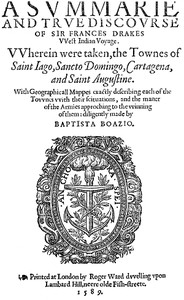
A Svmmarie and Trve Discovrse of Sir Frances Drakes VVest Indian Voyage Wherein were taken, the townes of Saint Iago, Sancto Domingo, Cartagena & Saint Augustine. — Story, Setting & Ideas
(0 User reviews)
357
Project Gutenberg
2006
Not confirmed
Explorers -- Great Britain -- Biography; Drake, Francis, approximately 1540-1596 -- Travel -- West Indies; West Indies Expedition, 1585-1586; Explorers -- America -- Biography
Readers of public-domain and historical texts
Project Gutenberg digital edition
en
Edition facts
Words
15,970
Reading time
70 min
Text sections
2
This digital edition of A Svmmarie and Trve Discovrse of Sir Frances Drakes VVest Indian Voyage Wherein were taken, the townes of Saint Iago, Sancto Domingo, Cartagena & Saint Augustine. — Story, Setting & Ideas is described by source-level measurements including 15,970 words, 1 hr 10 min estimated reading time, and 2 detected text sections.
The text analysis averages about 37.7 words per sentence, while the detected sections provide another way to judge how the source is divided.
Project Gutenberg metadata also associates the work with “Explorers -- Great Britain -- Biography,” connecting these edition facts with the source record’s subject description.
Source:
Project Gutenberg record #19589
Walter Bigges's firsthand account of Drake's 1585-86 West Indian campaign, detailing assaults on Spanish towns with precise descriptions of fortifications, troop movements, and the author's own role as a lieutenant.
Read the complete public-domain text at its original source.
Read on Project GutenbergWalter Bigges's narrative of Sir Francis Drake's West Indian voyage is distinguished by its tactical precision and firsthand authority. Bigges, who died during the expedition, wrote as a participant—he served as lieutenant to Master Carleil—and his account is filled with specific measurements, such as a strait "not aboue fiftie paces ouer," and detailed descriptions of Spanish defenses, including stone walls, barricades of wine butts filled with earth, and the placement of artillery. The text's value lies not in grand strategy but in the granular detail of how a few English soldiers overcame fortified positions through disciplined assault, using the cover of darkness and low tide to approach.
A Participant's Eye for Terrain and Fortifications
Bigges writes as a soldier who measured ground in paces and noted the precise composition of enemy works. At Cartagena, he describes a strait fortified "cleane ouer with a stone vvall and a ditch without it," flanked by two galleys mounting eleven pieces of ordnance. The barricade of "vvine buts or pipes, filled vvith earth" is noted as standing "euen vvithin the maine sea." This is not a general's overview but a lieutenant's report, attentive to the physical obstacles his men faced. The account of the assault itself is equally concrete: the English approached "by the lovvest ground" along the sea-wash shore, where the tide had fallen, and forbore shooting until they reached the wall. The moment of contact is rendered in a burst of action—"dovvne vvent the buts of earth, and pell mell came our svvordes and pikes together"—but the tactical reasoning behind each move is made explicit.
The Voice of the Dedication: Authority and Purpose
The prefatory dedication to Robert Devereux, Earl of Essex, signed by "T. C.," frames the text as a recovered manuscript—"a copie of the Discourse" that Bigges began and that was finished after his death by his lieutenant, Master Croftes, or another. The dedicatory writer claims to have been "a member in the said actions" and lieutenant of Carleil's company, thus vouching for the report's truth. This layered authorship—Bigges's original, a continuator, and a dedicatory sponsor—creates a complex textual authority. The dedication also reveals a political purpose: published a year and a half after the voyage, it aims to counter doubts about Spanish preparations by showing "what great victories a fewe English men haue made." The narrative is thus both a record and a piece of propaganda, intended to reassure and inspire.
Diction of Danger: Poisoned Arrows and Close Combat
Bigges's language becomes most vivid when describing the hazards of close engagement. The Spanish employed Indians as bowmen, "with their Arrovves most villanously empoisoned," so that a mere skin break could be fatal. This detail recurs with emphasis, marking a specific fear distinct from gunfire or pike work. In the assault on the barricade, the English advantage is spelled out in material terms: "Our pikes vvere somevvhat longer then theirs, and our bodies better armed, for very fevve of them vvere armed." The fight is described as a physical contest of weapons and armor, not of courage alone. The Lieutenant General kills the chief ensign bearer "with his ovvne hands," a personal act of violence that underscores the commander's direct role. These passages ground the narrative in the sensory and material realities of 16th-century warfare.
Structure and Omission: What the Excerpts Leave Unsaid
The available excerpts cover only the Cartagena assault and the prefatory matter; the accounts of Saint Iago, Santo Domingo, and Saint Augustine are absent. This fragmentary view limits any assessment of the voyage's overall arc or the relative difficulty of each target. What is clear is Bigges's method: each engagement is broken into phases—approach, defensive description, assault, and aftermath—with careful attention to ground, fortifications, and troop disposition. The narrative does not dwell on motives or morale; it reports actions and their immediate results. Readers should note that the full text likely extends this pattern across multiple sieges, offering a comparative view of Spanish colonial defenses. The missing geographical maps by Baptista Boazio, mentioned on the title page, would have complemented the verbal descriptions with visual precision.
Bigges's account rewards readers who attend to its tactical details rather than seeking a heroic narrative. The prose is lean, the observations precise, and the authorial voice that of a professional soldier recording what he saw and did. For those interested in the mechanics of early modern warfare, colonial fortifications, or the texture of Elizabethan expeditionary writing, this summary offers a rare, unvarnished perspective—one that values the width of a strait and the length of a pike over the glory of a commander.
There’s something almost melancholy in reading Bigges’ precise lists of captured towns, knowing how quickly those gains faded. I keep thinking about that sort of trust in a record, and it reminds me of The history of the life and adventures of Mr. Duncan Campbell — Inside the Classic, which has its own strange way of taking memory seriously. A quiet echo, across centuries.
There are no reviews for this eBook.
There are no comments for this eBook.
Reader reflection
What was your reading experience?
Capture what you thought, learned, and would like to remember.
Your progress
0
/
10
2
Was reading this book enjoyable?
3
Would you recommend this book to another reader?
4
How easy was the book to follow?
5
What was its emotional impact?
6
Did you relate to its people, ideas, or situations?
7
Would you read this book again?
8
Could you apply anything you learned?
9
What changed or sharpened your thinking?
10