
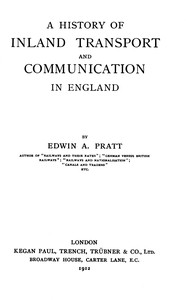
A History of Inland Transport and Communication in England by Edwin A. Pratt
Edwin A. Pratt’s book is a journey across centuries of English dirt, stone, and iron. It starts in a time when getting from London to York was a risky, week-long adventure on terrible roads, and ends with the birth of the railway network that shrank the entire country.
The Story
This isn’t a story with a single hero. Instead, it’s about the evolution of a system. Pratt walks us through the age of packhorses and awful roads, then shows how the desperate need for better movement sparked the Turnpike Trusts—private groups that built toll roads. From there, we hit the ‘Canal Mania’ of the 18th century, where artificial waterways became the high-speed internet of their day, moving coal and goods like never before. The final act is the explosive arrival of the railways, which didn’t just improve travel; they shattered old concepts of time and distance, created new cities, and changed everyday life forever. Pratt connects these dots, showing how each step forced the next.
Why You Should Read It
What makes this book stick with you is its focus on the why and the who. It’s not just that railways were invented; it’s about the fierce battles between canal owners and railway promoters, the political lobbying, and the vision (and greed) of industrialists. You see the constant push-pull between private money and public need. Pratt makes you feel the immense physical and financial effort behind every mile of track or canal. You finish it realizing that the landscape we take for granted—the routes of our roads and train lines—is a physical record of these old economic wars and brilliant engineering fixes.
Final Verdict
Perfect for anyone with a curiosity about how things came to be. If you’ve ever wondered why a town is where it is, or felt a sense of awe in a grand old train station, this book provides the backstory. It’s a must-read for history buffs who enjoy social and economic angles more than just kings and battles, and it’s a treasure for transport enthusiasts. Fair warning: it’s detailed and written in an early 1900s style, so it requires a bit of focus. But if you give it that, you’ll be rewarded with a completely new lens on the world outside your window.
You are viewing a work that belongs to the global public domain. Preserving history for future generations.
Noah Hernandez
1 year agoCompatible with my e-reader, thanks.
Mark Martinez
1 year agoWow.
Ashley Lee
9 months agoThe fonts used are very comfortable for long reading sessions.
Daniel King
1 year agoTo be perfectly clear, it provides a comprehensive overview perfect for everyone. Exceeded all my expectations.




Mason Davis
8 months agoI was skeptical at first, but it manages to explain difficult concepts in plain English. I couldn't put it down.